|
Getting your Trinity Audio player ready...
|
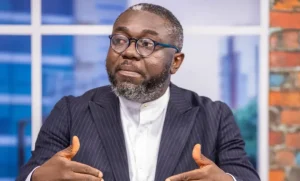
Constitutional Rights and Policy Strategy Advisor at Democracy Hub and private legal practitioner, Oliver Barker-Vormawor, says the Supreme Court’s decision on the Office of the Special Prosecutor (OSP) Act highlights the need for constitutional reforms to address weaknesses in Ghana’s prosecutorial system.
His comments follow the Supreme Court’s unanimous ruling upholding the constitutionality of the Office of the Special Prosecutor Act, 2017 (Act 959), while affirming that the Attorney-General has the authority to discontinue prosecutions initiated by the OSP.
Speaking to journalists after the ruling, Mr. Barker-Vormawor, whose organisation participated in the case as an amicus curiae, said the judgment reaffirms the Attorney-General’s constitutional supervisory role over criminal prosecutions.
He noted that the ruling also reveals limitations within the current constitutional framework and strengthens calls for an independent mechanism to investigate and prosecute corruption-related offences.
According to him, there is a growing demand for reforms that would create a system beyond the direct control of the Attorney-General’s office to enhance accountability in corruption cases.
Mr. Barker-Vormawor added that although the Attorney-General has the discretion to enter a nolle prosequi to discontinue criminal proceedings, the power must be exercised in accordance with constitutional principles.
He welcomed the Attorney-General’s commitment to provide reasons whenever the power is used, describing it as a positive move towards transparency and accountability.
However, he stressed that such decisions must remain subject to scrutiny to ensure they align with justice and the rule of law.
“The court has given us a clear direction that we need constitutional reform to fix some of the issues that have come up. There is an appetite across board for an independent process in investigating these issues beyond the Attorney-General, and I hope we carry that forward into substantive reforms,” he said.
Story by Efua Nessa