|
Getting your Trinity Audio player ready...
|
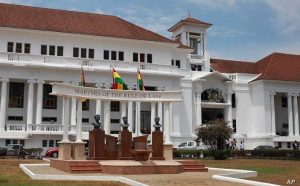
The Supreme Court has, by a 5–2 majority decision, declared the delegate system used by political parties to elect presidential and parliamentary candidates unconstitutional.
The Court has directed all political parties to replace the system with a process that allows all members in good standing to participate directly in their internal primaries.
The ruling requires political parties to put in place the necessary arrangements within one year to ensure that eligible members can vote in the selection of presidential and parliamentary candidates.
The case was brought before the Court by Prof. Kwabena Frimpong-Boateng, Dr. Nyaho Nyaho-Tamakloe and Dr. Christine Amoako-Nuamah, who argued that the delegate system excludes ordinary party members and violates the democratic principles outlined in the 1992 Constitution.
In its ruling, the Court held that the delegate system creates a limited voting structure that can encourage money politics. It added that opening party primaries to all qualified members would strengthen political participation, accountability and constitutional democracy.
The Court also ruled that the Electoral Commission has a role in ensuring political parties operate in line with constitutional requirements and consequently granted all the reliefs requested by the plaintiffs.
Political parties have therefore been barred from continuing to use the delegate system for selecting their presidential and parliamentary candidates and must adopt a new arrangement that gives all eligible members voting rights within the one-year period.
However, the Court clarified that decisions, appointments and actions already taken under the previous system remain valid and will not be affected by the judgment.
The seven-member panel was made up of Chief Justice Paul Baffoe-Bonnie, Justice Gabriel Scott Pwamang, Justice Issifu Omoro Tanko Amadu, Justice Samuel Kwame Adibu-Asiedu, Justice Senyo Dzamefe, Justice Ernest Yao Gaewu and Justice George Kingsley Koomson.
The majority decision was supported by five members of the panel, while Justices Samuel Kwame Adibu-Asiedu and Ernest Yao Gaewu dissented.
Story by Efua Nessa