|
Getting your Trinity Audio player ready...
|

Minority Leader Alexander Afenyo-Markin has distanced himself from a social media post in which he appeared to oppose Ghana’s anti-gay bill, claiming his account had been compromised. The now-deleted post read:
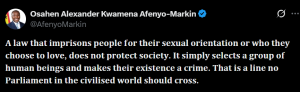
“A law that imprisons people for their sexual orientation or who they choose to love does not protect society. It simply selects a group of human beings and makes their existence a crime. That is a line no Parliament in the civilised world should cross.”
Afenyo-Markin offered no further details on how the alleged account breach occurred.
The Post vs. the Record
On the surface, his denial seems straightforward. Yet, Afenyo-Markin has expressed similar views on multiple occasions.
On November 28, 2023, during a TV3 interview as Deputy Majority Leader, he stated: “Personally, I don’t think that somebody claiming to be a lesbian or gay should go to jail by virtue of that.” He repeated this unprompted in the same interview.
On February 15, 2024, while speaking on the floor of Parliament, he argued that incarcerating people for their sexuality “would not be the solution” and warned that the bill’s custodial provisions “will be retrogressive.” He cited a prison visit during his law studies, noting that imprisonment does not correct behavior but can exacerbate it.
He also authored an academic paper, “The Case for Non-Custodial Sentencing and Plea Bargaining in Addressing Same-Sex Sexual Relationships,” advocating a justice approach rooted in the dignity of every person, favoring restorative over punitive measures.
The deleted post did not state anything Afenyo-Markin had not already publicly articulated.
Three Possible Interpretations
1. The account was genuinely hacked, and the post coincidentally mirrored Afenyo-Markin’s established views.
2. The post was authentic, and the hacking claim was used to retract it without formally doing so.
3. Afenyo-Markin personally opposes criminalisation, but leads a caucus whose official stance differs, creating tension now reflected in the viral post.
What the Record Confirms
Afenyo-Markin cannot disown his TV3 interview, parliamentary speech, or academic paper, all of which consistently oppose jailing individuals for their sexual orientation.
If the deleted post was fabricated, it merely echoed his prior statements. If it was genuine, the explanation for the alleged hacking becomes the focal point, not the post itself.
Next Steps for the Bill
The Human Sexual Rights and Family Values Bill awaits transmission to President Mahama. Speaking at Chatham House in London, Mahama raised concerns about quorum and procedural issues, outlining three options: assent, referral to the Council of State, or return to Parliament. He noted that the bill still has “quite a while to go” before becoming law.
Speaker Alban Sumana Kingsford Bagbin urged MPs to reconsider the bill, stressing that the legitimacy and authority of any law depend not only on its objectives but also on the integrity of the legislative process.
Should the bill return to Parliament, debates over its criminalisation provisions will resume, with Afenyo-Markin’s documented positions—including the one he now denies—likely forming part of the record.
Story by Efua Nessa