|
Getting your Trinity Audio player ready...
|
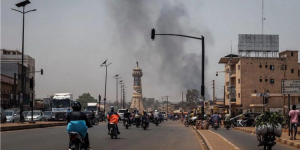
France warns against travel to Mali, urges citizens to leave “as soon as possible”
By Efua Nessa
France has urged its citizens to leave Mali “as soon as possible”, after a weekend of coordinated attacks by separatist fighters and Islamist militants.
In an update on Wednesday, the advice also warned French citizens not to travel to the West African nation, describing the situation as “extremely volatile”.
Explosions and sustained gunfire were reported across the country, including the capital, Bamako on Saturday. In Kati, the defence leader Sadio Camara was killed in an apparent suicide bombing by militants, while in the north, separatist forces have taken control of the city of Kidal.
Mali’s military leader Gen Assimi Goïta, said the security situation in the country was under control.
Speaking in public for the first time on Tuesday evening, he said the army had dealt a “violent blow” to the attackers, and signalled operations were still ongoing.
The spokesperson for one of the rebel groups, the ethnic Tuareg separatist Azawad Liberation Front (FLA), on Wednesday vowed: “the regime will fall, sooner or later”.
Speaking to AFP news agency during a visit to Paris, Mohamed Elmaouloud Ramadane said the rebels intended to take control of several other northern towns – Gao, Timbuktu and Menaka – following their success in Kidal.
He also called for Russian forces, who have been helping the military government against the rebel groups, to withdraw from “all of Mali” after they agreed to pull out of Kidal on Monday, April 27, 2026.
He told the BBC he was in Paris for a “private matter” and denied reports he was holding talks with French defence and security officials.
The foreign ministry of France, Mali’s former colonial power, said: “French nationals are advised to make arrangements to leave Mali temporarily as soon as possible on the commercial flights that are still available.”
Pending their departure, they should stay at home, limit their movements and follow instructions from local authorities, it said, adding that they should also keep their relatives informed.
“Travel to Mali is still strongly discouraged, regardless of the reason.”
The UK has also advised “against all travel to Mali due to the unpredictable security conditions”, and asked its citizens to leave.
The travel guidelines – which have been in place since the weekend – told British citizens in Mali to “leave immediately by commercial flight if you judge it safe to do so”.
It also warned them not to travel by land to neighbouring countries, deeming it “too dangerous” due to what it called “terrorist attacks along national highways”.
“If you choose to remain in Mali, you do so at your own risk. You should have a personal emergency plan that does not rely on the UK government,” the Foreign Office added.
Bamako International Airport is currently open, but travellers have been warned to check the latest information in case of delays or cancellations.
The US embassy in Mali said it was continuing to “closely monitor” the situation, and told citizens to “shelter in place, remain alert… and avoid areas where security operations may be underway”.
On Saturday, fighting was reported in Bamako, Kati, home to a major military base outside the capital, as well as in Gao and Kidal in the north, and the central cities of Sevare and Mopti. Clashes reportedly continued into Sunday in Kidal and Kati.
Reports suggest the assault by the FLA was primarily focused on northern areas claimed as parts of a Tuareg homeland, while the jihadist group Jama’at Nusrat al-Islam wal-Muslimin (JNIM) staged simultaneous attacks on multiple locations across the country.
Mali is currently ruled by a military junta led by Goïta, who first seized power in a coup in 2020, promising to restore security and push back armed groups.
The junta had popular support when it took power, promising to deal with the long-running security crisis prompted by the Tuareg rebellion in the north, which was then hijacked by Islamist militants.
UN peacekeepers and French forces deployed to deal with the escalating insurgency left after the junta took over, and the military government hired Russian mercenaries to help tackle the insecurity.
However, the jihadist insurgency has continued, and large parts of the north and east of the country remain outside government control.
Source:BBC.com