Pra River Under Attack: Galamsey Threatens Lifeline Of Assin Communities
By Prince Agyei Opoku
ASSIN ASEMPANEYE — The Pra River used to be clear enough for children to see their own feet.
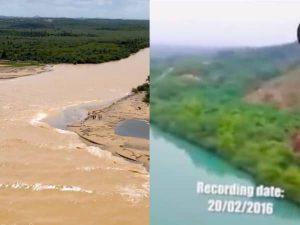
Today, at Assin Asempaneye, it runs thick and brown, like clay mixed with milk. Fishermen no longer cast their nets. Women no longer fetch water for cooking. And mothers warn their children not to play near the bank.
The river that once fed an entire district is dying — and the killer is not drought. It is galamsey.
“Our River Has Been Infected”
When this reporter visited Asempaneye, the anger in the community was loud and clear.
In an interview with residents, they emphasised how galamsey activities have destroyed the very water bodies that once served the entire community.
“The rivers that were serving us have now been infected,” one elderly woman told this paper, pointing to the brown Pra. “We used to drink from it, cook with it, bath with it. Now we are afraid to even touch it.”
Another resident, a mother of four, said the situation has become a health crisis.
“Our children are getting sick. We hear it is the cyanide and other chemicals they use to wash the gold. The water is no longer water, it is poison,” she said.
For the people of Asempaneye, this is not a distant environmental story. It is their daily life. The river they depended on for farming, fishing and drinking has become a source of disease.
“We have boreholes, but they are not enough for the whole town,” a young farmer added. “When the borehole breaks down, what do we do? We go back to the same poisoned river.”
A River That Fed A District
For generations, the Pra has been more than a river to the people of Assin.
It watered cocoa farms in Assin Asempaneye, Ntowkrom, Ayittey and Agave. It provided fish for the market. It served as drinking water, bathing water, and irrigation water for dozens of farming communities along its banks.
“It was our life,” says a 62-year-old farmer at Ntowkrom, who has lived by the river all his life. “When the Pra was clean, we had everything. Now we have nothing.”
That life began to change around 2021, when illegal miners began moving upstream — first with pickaxes and pans, then with excavators, water pumps and Changfan machines.
Today, the Pra in Assin North is not just polluted. In some places, its course has been diverted to make way for mining pits.
The Machines Have Taken Over
A visit to the mining sites at Ayittey and Agave reveals the scale of the destruction.
Excavators sit on the river bank, scooping sand and mud day and night. Pipes suck water directly from the river, mix it with mud, and pour the waste back into the same river. The banks are scarred, the trees are gone, and the water is a thick orange-brown.
In June last year, the National Anti-Illegal Mining Operations Secretariat (NAIMOS) raided sites in Ayittey, Agave, Assin Asempaneye and Ntowkrom. Five excavators were seized. Three more were immobilised.
But residents say the miners returned within weeks.
“They come in the night. When the task force leaves, they come back,” says a young man at Ayittey who asked not to be named for fear of reprisal. “The money is too big. One night’s work can feed a family for a month.”
Assembly Member: “We Must Fight Together”
The Assembly Member for the area, Mr. Elvis Brebo, says the fight against galamsey cannot be won by one person or one institution.
In an interview, Mr. Brebo stressed the need for all stakeholders to come together to fight the war against galamsey.
“This is not a fight for the Assembly Member alone, or for the chiefs alone, or for the police alone,” he said. “If we don’t come together — the chiefs, the youth, the farmers, the security agencies, the District Assembly and the government — we will lose this river completely.”
Mr. Brebo said the community is ready to support any genuine effort to stop the mining, but he warned that arrests alone will not work if the young people involved are not given alternatives.
“We need to protect the river, but we also need to give our youth something else to do. If we don’t, they will keep going back to the river,” he said.
Health Officials: “Children And Pregnant Women Are Suffering Most”
Health officials in the area say the galamsey menace must be fought now, because the health consequences are already visible — and the most vulnerable are suffering most.
Madam Adorley Yawson, a health official in the area, stressed in an interview that most of the patients reporting with water-related diseases are children.
“Most children are contracting diseases,” Madam Yawson said. “Skin rashes, diarrhoea, stomach infections, typhoid — we see them almost every day. And it is because they are using the polluted river water for bathing and drinking.”
Madam Yawson also raised serious concern about pregnant women in the area.
“Some pregnant women are also having issues,” she said. “When a pregnant woman drinks water contaminated with mercury and cyanide, it does not affect only her. It affects the unborn child too. We are worried about miscarriages, low birth weight, and babies born with complications.”
She warned that boiling the water does not make it safe, because boiling kills bacteria but cannot remove mercury, cyanide and arsenic.
Madam Yawson called for urgent intervention — clean water supply, regular health screening for children and pregnant women, and a total stop to mining in the Pra.
“If we don’t fight this now, we will be treating the sicknesses for years, but the cause will still be in the river,” she said.
Downstream, The People Pay
While the miners make money upstream, the people downstream are paying with their health.
At Assin Asempaneye, women now walk over two kilometres to find a borehole. Those who cannot afford to buy sachet water are forced to use the Pra — and they are getting sick.
For farmers, the damage is double. Irrigating cocoa and food crops with polluted water poisons the soil. Some farmers say their yields have dropped by half.
“I used to harvest 15 bags of cocoa,” says a farmer at Ntowkrom. “Last season, I got seven. The water I use to spray my farm is the same water the miners use to wash gold.”
A Lifeline At Breaking Point
As evening falls over Assin Asempaneye, the river is quiet. No children swim. No fishermen sing. Only the distant sound of a machine, somewhere in the bush, digging.
The Pra has survived droughts, floods and wars. But it may not survive galamsey.
If the mining continues, Assin will lose more than a river. It will lose its farms, its fish, its drinking water, and its future.
“This river gave birth to us,” says the old farmer at Ntowkrom, staring at the brown water. “If the Pra dies, we die with it.”